Risk profile, tax treatment, and account size resolve to one specific model portfolio — every time, with the same inputs. Nine purpose-built sleeves, fifteen allocation configurations, eight stress scenarios, and three implementation tiers.
The Allocation Tool is available to pilot participants. These are real screens from the current build — the allocation output, the stress test panel, and the implementation tier comparison.
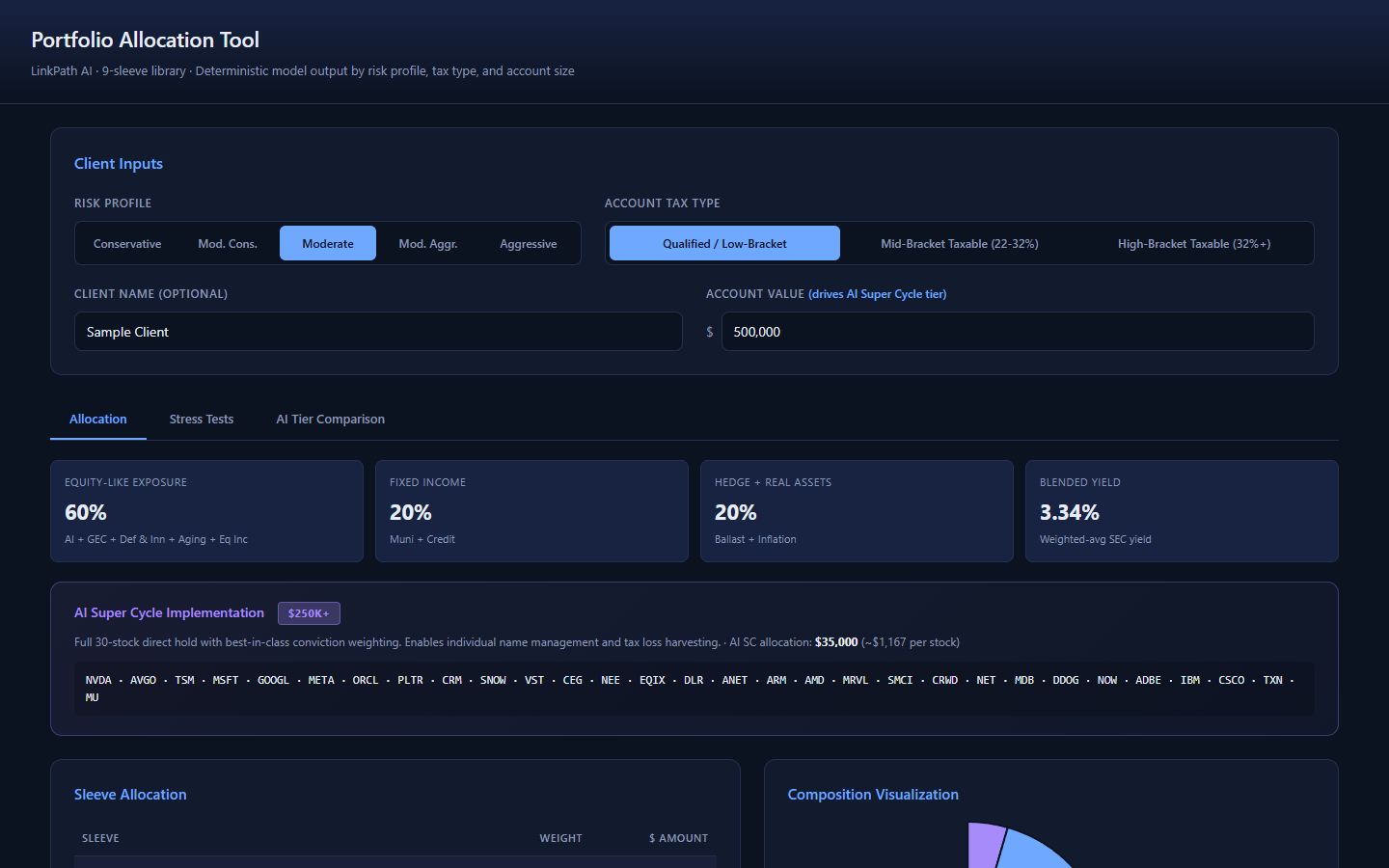
01 · Allocation view
Allocation view showing sleeve mix, AI Super Cycle tier, and blended yield for a Moderate/Qualified/$500K account.
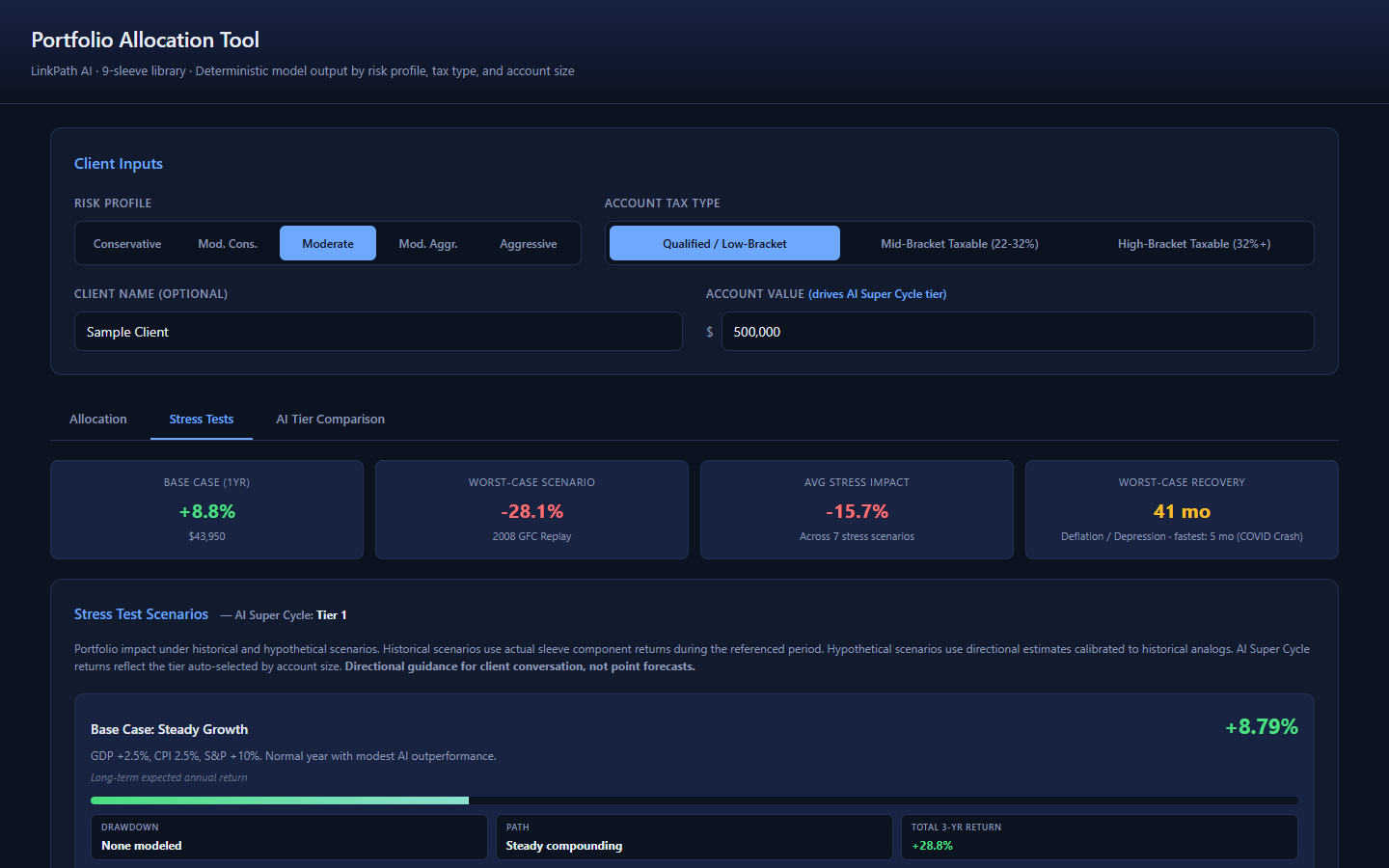
02 · Stress testing
Stress test scenarios with real historical drawdowns and recovery timing — including 2022 Rate Shock, 2020 COVID Crash, and 2008 GFC.
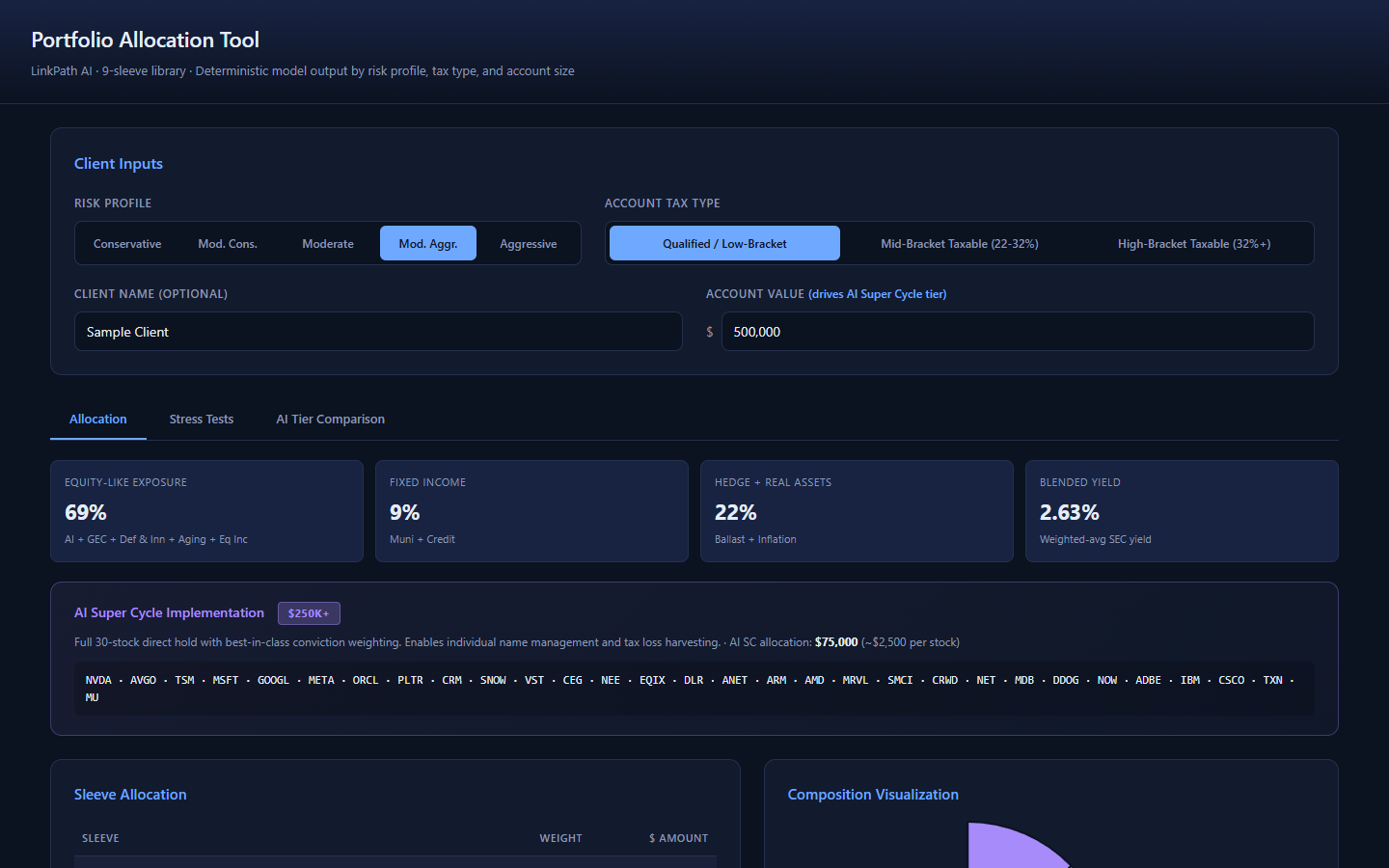
03 · Tier comparison
Compare all three AI Super Cycle implementations (30-stock direct, 12-stock focused, ETF basket) across all 8 stress scenarios.
There is no optimizer to babysit and no black box to explain away. The advisor supplies three facts about the account and the tool resolves a specific, reproducible allocation with an implementation path attached.
Five risk profiles crossed with three tax types produce fifteen allocation configurations. Account size then selects the implementation tier — the same target allocation is expressed differently in a $60,000 IRA than in a $1.2M taxable household. Nothing is interpolated, guessed, or model-generated: each of the fifteen configurations is authored, reviewed, and versioned.
Five profiles span conservative through aggressive. The profile sets the growth-to-ballast ratio and the ceiling on thematic sleeve exposure.
Taxable, tax-deferred, and tax-free registrations route income exposure to the appropriate sleeve — Core Taxable Income versus Core Tax Free Income — instead of leaving after-tax placement to chance.
Account size selects the AI Super Cycle implementation tier: a 30-stock direct sleeve, a 12-stock focused sleeve, or a five-ETF basket for smaller accounts.
The resolved allocation runs against eight scenarios so the conversation moves from "what do you think markets will do" to "here is how this behaves if they don't cooperate."
Every sleeve exists to do something specific in the portfolio. Nothing is included because it fills a style box, and nothing is included twice under a different label.
Concentrated exposure to the compute, semiconductor, power, and data-infrastructure chain behind the AI build-out. Implemented in three tiers by account size so the concentration is deliberate rather than accidental.
The low-cost, broadly diversified equity backbone of every profile. Holds the portfolio's baseline market exposure so the thematic sleeves can be sized honestly against it.
Defense primes, aerospace, cybersecurity, and dual-use industrial technology. A structurally funded, policy-driven spending cycle with return drivers largely independent of the consumer economy.
Healthcare delivery, medical devices, pharmaceuticals, and the services layer around an aging population. A slow, high-visibility demand curve that rarely reprices on a single quarter.
The sleeve designed to behave differently when equities break. Sized to matter in a drawdown without dragging the portfolio through long stretches of normal markets.
Real estate, infrastructure, commodities, and energy exposure. Carries the portfolio's inflation-sensitive weight and diversifies away from purely financial cash flows.
Dividend-paying equities with durable payout coverage. Provides cash flow while retaining equity participation for households that still need growth alongside distributions.
The fixed income allocation for taxable-registration and tax-deferred dollars, where taxable yield is the efficient choice. Duration and credit posture are set at the profile level.
The municipal counterpart, routed automatically when the registration and tax treatment make tax-exempt yield the better after-tax outcome. Same role in the portfolio, different tax wrapper.
A thirty-position direct sleeve is right for one household and unmanageable for another. The tool selects the implementation by account size so the thesis stays constant while the mechanics stay practical.
Direct ownership of thirty individual positions across the full compute, semiconductor, power, and infrastructure chain. Supports tax-loss harvesting at the position level and full transparency into every name.
A concentrated twelve-position expression of the same thesis. Keeps position sizes meaningful and the trade blotter manageable at mid-size account levels without dropping to a pure fund wrapper.
A five-fund basket delivering the same exposure map at small account sizes, with no odd-lot problems and no unmanageable position count.
Not a generic risk score and not a forecast. Each scenario applies a defined set of factor shocks to the resolved sleeve weights so the client sees how this portfolio — not a representative one — behaves under stress.
Reference path with no shock applied. The comparison point for everything else.
Inflation stays elevated well beyond consensus. Tests real-asset weight and duration exposure.
Rapid repricing of rates with stocks and bonds falling together. Tests the ballast assumption directly.
Weak growth alongside sticky prices. The hardest environment for a conventional balanced portfolio.
A sharp de-rating of AI-linked equities. Sizes the cost of the thematic sleeve when the thesis breaks.
A fast, deep, liquidity-driven drawdown with an equally fast recovery. Tests behavior and rebalancing discipline.
Falling prices and falling nominal growth. Rewards duration and punishes commodity-linked exposure.
A prolonged credit-driven equity collapse with correlations converging toward one.
The Allocation Tool is deep-linkable from RegiMint inside the pilot environment. When a discovery session finishes, the risk profile, tax treatment, and account size travel with the handoff — the advisor lands on the resolved model with nothing re-keyed.
Discovery output becomes allocation input directly. The advisor moves from "here is where your plan has gaps" to "here is the portfolio that addresses them" inside the same meeting, and the client never watches anyone retype a questionnaire.
Because the resolution is deterministic, the model the client sees in the meeting is the same model that appears when the advisor reopens the link that evening.
LinkPath is running a founding-cohort pilot with select advisors. Pilot participants receive early access, direct input into product roadmap, and preferred pricing at general release.